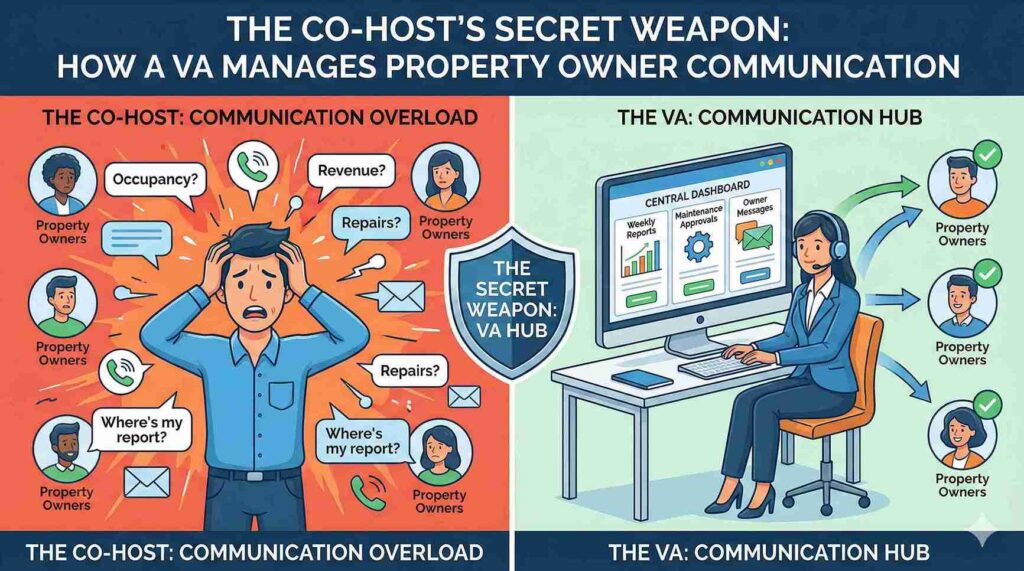
A virtual assistant manages property owner communication for co-hosts by sending weekly performance reports, coordinating maintenance approvals, and handling questions so the co-host can focus on growing the business instead of chasing updates.
If you manage short term rentals for other people, you know that keeping the owners happy is just as important as keeping the guests happy. Owners want to know their investment is safe and profitable. Because of this, they ask a lot of questions. They text you about occupancy rates, email you about revenue, and call you about maintenance costs.
This daily back-and-forth eats up your time and creates friction. This is exactly where STR Super VA steps in. Our specialized team acts as your communication hub. We keep your property owners informed and confident, while you get your time back.
Why Owner Communication Is the Co-Host’s Biggest Time Drain
Most property managers spend 20 to 30 percent of their week just talking to their clients. As your portfolio grows, this communication load becomes impossible to handle alone.
Owners frequently ask the exact same questions. They want to know, “How much did we make last month?” or “Why was our occupancy low this week?” They also want details like, “Did you approve that plumber repair?” If you do not answer quickly, owners get nervous.
When communication slips, you lose trust. Unhappy owners will eventually take their properties to another manager. Managing this relationship takes a massive emotional toll and leads directly to co-host burnout.
The Virtual Assistant as Communication Hub
A virtual assistant for STR co-hosts is the person who sits right between your owners and your daily operations. They act as a professional filter. They handle all the routine updates, send the reports, and answer the basic questions.
Your VA does not make up answers. They follow the specific templates and processes that you set. They gather the data, format it beautifully, and send it out on a strict schedule. If an owner asks a complex question or if a major decision is needed, the VA simply escalates that single issue to you.
This system creates total consistency. Your owners receive professional, transparent updates every single week without you lifting a finger.
Weekly Owner Updates: The Foundation of Trust
The secret to great co-host owner communication is being proactive. If an owner has to ask you for an update, you are already behind.
Consistent, scheduled communication builds incredible trust. A weekly or monthly update shows the owner exactly what is happening with their asset. These property owner updates usually include the current occupancy percentage, the revenue compared to the budget, upcoming maintenance needs, and a quick summary of guest feedback.
Your VA logs into your Property Management System (PMS), your Airbnb dashboards, and your bookkeeping software to pull this data. They compile it into an easy-to-read format and send it out automatically.
Sample Weekly Owner Report
Here is a look at a standard co-host performance reporting template that your VA will use:
| Section | What It Shows | Why Owners Care |
| Occupancy Summary | Last week’s booked percentage versus the target goal. | Gives a basic pulse on performance health. |
| Revenue Snapshot | Gross bookings, cleaning fees, and net payouts to the owner. | Shows exactly how much money was made this period. |
| Upcoming Bookings | The reservation pipeline for the next 30 days. | Provides forward visibility and peace of mind. |
| Maintenance & Expenses | Recent repair costs and any upcoming estimated costs. | Creates budget awareness and prevents surprises. |
| Guest Highlights | Top reviews and any minor issues flagged by guests. | Proves your quality control is working. |
| Action Items | Specific decisions needed from the owner. | Gives clear, simple next steps. |
Step-by-Step: How a VA Handles Owner Communication Each Week
Here is the exact workflow your VA follows to keep your clients happy.
- Review Data: The VA pulls the previous week’s data from your PMS, OTAs, and financial software.
- Draft the Update: They draft the standard weekly owner update using your approved template.
- Flag Issues: They flag any items needing owner approval, such as large repairs or low performance alerts.
- Send the Report: They send the update via email or a shared dashboard with a clear subject line.
- Answer Questions: They respond to basic owner questions within 24 hours using prepared responses.
- Log Everything: They log all communication and decisions in a shared tracker for you to review.
- Escalate: They escalate anything unusual directly to you, like an upset owner or a major revenue opportunity.
Managing Maintenance and Expense Approvals
Maintenance is a huge point of friction. Owners hate surprise bills. Your VA smooths this out by managing the approval workflow perfectly.
When a repair is needed, the VA documents the issue, gets quotes from your vetted vendors, and sends a clean approval request. They provide clear cost breakdowns.
For example, the VA will message the owner: “A toilet repair is needed at the Main Street property. We have a quote for $250 from our trusted plumber. Do you approve this expense?” This completely eliminates long email threads and builds massive owner confidence.
Financial Reporting: Monthly Owner Statements
At the end of the month, owners want to see the big picture. Your VA handles the heavy lifting of monthly property owner updates.
These monthly statements include Profit and Loss summaries, detailed expense breakdowns, and year-to-date performance tracking. Your VA prepares these documents using data from tools like QuickBooks, Stessa, or the financial modules inside your PMS.
Clean, accurate financial communication is the number one reason owners renew their contracts and refer other investors to your management company.
Handling Common Owner Questions and Concerns
Owners will always have questions. Your VA uses a playbook of prepared responses to handle them professionally while still sounding personal.
- Low occupancy: The VA explains current market trends, seasonality, and the specific actions you are taking to boost bookings.
- Guest complaints: The VA shares how the issue was resolved and the steps taken to prevent it from happening again.
- Revenue dips: The VA shows historical comparisons and highlights the upcoming booking pipeline to ease worries.
- Rate strategy: The VA explains the logic behind your dynamic pricing software and how it maximizes overall profit.
Communication Channels: Email, Slack, Portal, or Phone
Different owners prefer different communication methods. Your VA adapts to these preferences to provide a premium service.
Email is the most common and provides a great paper trail. Some co-hosts use Slack or specialized owner portals for faster updates. Your VA will manage whichever tool you prefer. The most important factor is documentation. The VA ensures every decision is written down and logged.
Phone calls are kept extremely rare. Your VA handles the day-to-day written updates, saving phone calls for you to use only for complex escalations or relationship building.
VA vs Co-Host Handling Owner Communication
Here is how delegating this task changes your daily life.
| Task | Co-Host Does It | VA Handles It |
| Weekly Performance Reports | Takes 2 to 3 hours manually | Done in 30 minutes using templates |
| Maintenance Approvals | Messy back-and-forth texts | Clean, single approval requests |
| Owner Questions | Interrupts your daily operations | Filtered, batched, and answered fast |
| Monthly Financials | Stressful manual compilation | Pulled directly from PMS data |
| Relationship Management | High stress and reactive | Consistent, proactive professionalism |
How This Fits Into Larger Co-Host Operations
Owner communication is just one piece of the property management puzzle. To be truly successful, all your systems need to talk to each other.
Your communication VA works right alongside your operations team. They connect the owner updates directly to guest messaging, cleaner turnovers, listings management, and bookkeeping. In fact, the same VA team can handle all of these tasks, creating a perfectly unified system for your business.
To see the full picture of how this works, learn what an STR VA does across all departments.
FAQs
What information does a VA need to start handling owner communication?
They need access to your PMS, your dynamic pricing tool, and your communication templates. They also need a list of your owners and their preferred contact methods.
How do you make sure owners feel like they are talking to the co-host, not a VA?
The VA uses an email address from your company domain. They write using inclusive language like “our team” or “we,” positioning themselves as your dedicated account manager rather than an outsourced worker.
Can a VA handle multiple owners with different communication styles?
Yes. A trained VA keeps detailed notes on each owner. If Owner A wants a detailed spreadsheet and Owner B just wants a short bulleted email, the VA adapts to those specific preferences.
What happens if an owner has a question the VA cannot answer?
The VA acknowledges the question immediately. They tell the owner, “That is a great question. Let me check with the senior management team and get right back to you.” They then escalate the question to you for the final answer.
How much time does this save a co-host managing 10 properties?
A co-host with 10 properties typically saves 10 to 15 hours every single week by delegating report creation and routine owner questions to a VA.
Scale Your Portfolio With Better Communication
Co-hosts can only scale their portfolios when they stop doing everything themselves. A trained VA becomes your secret weapon for owner communication.
By delivering consistent reports and handling the daily questions, your VA gives you total time freedom. You get to focus on signing new properties, while your current owners stay happy, informed, and trusting of your management.
Stop drowning in owner emails. Review the pricing for co-host support and get started with STR Super VA today to build a better system.