
Hiring a trained short-term rental virtual assistant is one of the few business decisions that can pay for itself within the first month.
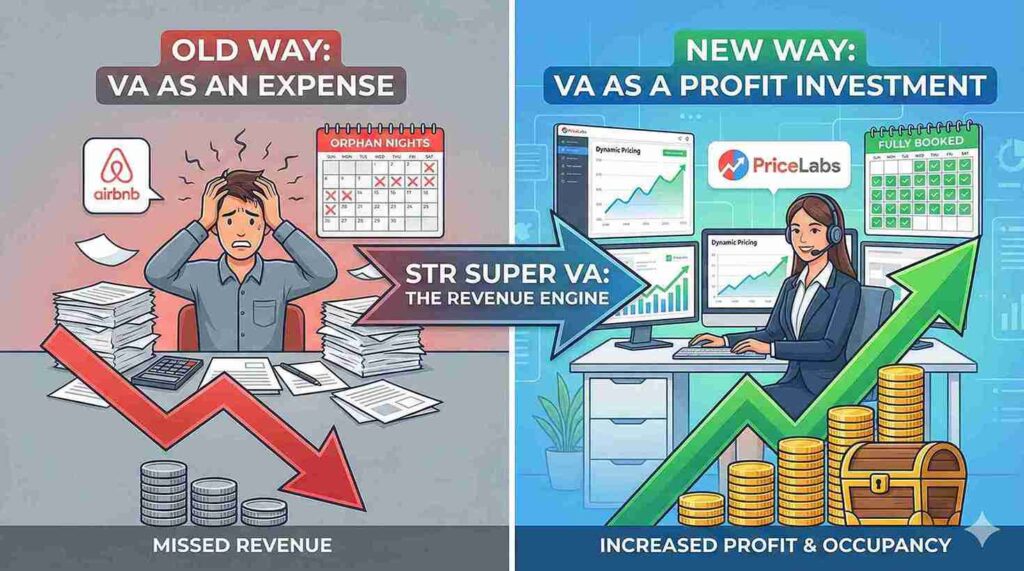
Many Airbnb hosts view a Virtual Assistant (VA) strictly as an operational cost—someone to handle the “drudge work” of guest messaging or cleaning coordination. While that is true, it misses the bigger picture. When utilized correctly, a trained STR Super VA becomes a revenue generator who actively increases your occupancy and nightly rates.
If you are just “setting and forgetting” your prices, or relying entirely on an algorithm without human oversight, you are leaving money on the table. By delegating revenue management to a specialist who understands dynamic pricing strategy, you turn an expense into a high-yield investment.
The Real ROI of a Virtual Assistant
In the current short-term rental market, competition is fierce. The days of charging a flat rate for weekdays and weekends are over. To maximize profit, you need to adjust your strategy daily based on market supply, local events, and booking windows.
The problem? You don’t have time to stare at a dashboard for an hour every morning.
This is where a short-term rental virtual assistant changes the game. Instead of just answering questions, they act as your dedicated revenue manager. They ensure your calendar is optimized to capture every possible dollar, often covering their own monthly fee by filling just two or three extra nights that would have otherwise gone unbooked.
Dynamic Pricing: The Airbnb Host’s Secret Weapon
Dynamic pricing is the strategy of adjusting your nightly rates in real-time based on demand. Airlines and hotels have done this for decades. Now, tools like PriceLabs, Wheelhouse, and Beyond make it accessible for Airbnb hosts.
However, these tools are not magic wands. They are algorithms. They need a human pilot to steer them correctly. An algorithm might know that demand is high in October, but it might not know that the local Taylor Swift concert just got canceled, or that a new competitor opened up next door undercutting you by $50.
What a PriceLabs Virtual Assistant Actually Does
A “PriceLabs Virtual Assistant” is simply an STR VA who has been trained to use dynamic pricing software effectively. They don’t guess; they use data to make informed decisions that boost your bottom line.
Here is what that looks like in daily practice:
- Market Rate Tracking: They monitor your local competition to see if you are overpriced (losing bookings) or underpriced (losing profit).
- Orphan Night Gap Filling: They identify 1-2 day gaps between bookings—”orphan nights”—and create specific discounts or rules to get them filled.
- Seasonal Rate Tuning: They proactively adjust minimum stay requirements for holidays or high-demand seasons months in advance.
- Daily Dashboard Review: They check your pricing tool daily to ensure the algorithm hasn’t made a mistake, like pricing a luxury home at a bargain-basement rate due to a glitch.
Comparison: Manual vs. VA-Managed Pricing
| Feature | Manual Host Management | VA-Managed with Pricing Tools |
| Frequency | Weekly or Monthly (when you remember) | Daily (consistent oversight) |
| Orphan Nights | Often left empty (0% revenue) | Aggressively filled (100% revenue) |
| Event Strategy | Reactive (often too late) | Proactive (adjusts months ahead) |
| Data Usage | Gut feeling / “Set and forget” | Real-time market data & trends |
Increasing Occupancy Without Lowering Standards
A common fear hosts have is that a VA will just lower prices to get bookings, attracting low-quality guests. A trained STR Super VA knows better.
The goal isn’t just “more bookings”; it is “profitable bookings.”
Your assistant can implement sophisticated strategies to increase occupancy without a “race to the bottom.” For example, they can adjust your minimum stay settings. If you usually require a 3-night minimum, but you have a 2-night gap on a Tuesday and Wednesday, the VA can manually override the setting for just those dates.
This micro-management allows you to capture a booking you would have been invisible to, without permanently lowering your standards or prices.
The VA Behind the Dashboard: STR Expertise in Action
Software is powerful, but it lacks context. A generic virtual assistant from a freelance marketplace won’t know the difference between “ADR” (Average Daily Rate) and “RevPAR” (Revenue Per Available Room).
At STR Super VA, we train our assistants specifically on short-term rental workflows. They understand that a 5% increase in occupancy during the slow season can mean thousands of dollars in difference at the end of the year.
This human insight is critical for Local Event Mapping. An automated tool might see a spike in demand, but a human VA can research why that spike is happening. Is it a conference? A sports game? Knowing the “why” allows them to tailor your listing title or description to attract those specific travelers, converting views into bookings.
ROI Breakdown: Why a VA Pays for Itself
Let’s look at the math. A full-time or dedicated part-time STR VA might cost you around $799/month. That sounds like a cost until you look at the revenue impact.
Imagine your property averages $200 per night.
- Scenario A (No VA): You have 5 unbooked “orphan nights” this month because your minimum stay settings blocked them. Revenue lost: $1,000.
- Scenario B (With VA): Your VA spots those gaps, adjusts the minimum stay to 1 night, and tweaks the price slightly. All 5 nights get booked. Revenue gained: $1,000.
In this simple scenario, the VA has already paid for their entire monthly fee just by filling gaps you didn’t have time to manage. Every other task they do—guest messaging, cleaning coordination, review management—is essentially “free” to you at that point.
Real-World Scenario: The Festival Surge
Consider a host in Austin, Texas, during the SXSW festival.
Without a VA: The host sets high prices for the festival week. However, two weeks out, bookings are slow. The host is busy at their day job and forgets to check the market. The dates go unbooked or get booked last minute at a panic-discounted rate.
With a VA: The VA notices 6 weeks out that booking pace is slower than competitors. They make a small pricing adjustment—lowering the rate by just 5% to undercut the competition while maintaining a premium. The listing gets booked immediately at a high rate, locking in revenue while other hosts are left empty.
This is Booking Window Analysis in action. It requires daily attention, which is exactly what your VA provides.
Setting Up Your Own Revenue Machine
To turn your VA into a revenue manager, you need a clear process. You cannot just hand over the password and hope for the best.
- Grant Access: Set up your VA as a team member on PriceLabs, Wheelhouse, or your PMS.
- Define Guardrails: Give them a “Floor Price” (the absolute lowest rate you will accept) so they never price you too low.
- Establish Routine: Require a daily check of the dashboard and a weekly report on occupancy trends.
- SOP Templates: Use Standard Operating Procedures to define how to handle orphan nights and last-minute discounts.
When you hire through a specialized agency, many of these workflows are already understood by the talent, reducing your training time significantly.
FAQ: Revenue Management & VAs
Can a VA really replace a Revenue Manager?
For most hosts with 1-50 units, yes. A trained VA using powerful software like PriceLabs effectively acts as a revenue manager, handling 90% of the optimization tasks at a fraction of the cost of a specialized consultant.
What tools do STR VAs use for dynamic pricing?
Most experienced STR VAs are comfortable with PriceLabs, Wheelhouse, and Beyond. They also work within PMS dashboards like Guesty, Hospitable, and Hostaway to execute these strategies.
Can a VA adjust for local festivals automatically?
While tools detect demand spikes, a VA adds the context. They can manually adjust your listing titles to mention the festival (“Walk to Coachella!” or “Perfect for Sundance!”) which improves visibility and conversion rates during those high-demand periods.
Conclusion: Scale Beyond Management
If you view your virtual assistant as just an expense, you will always try to minimize what you pay them. But if you view them as an asset that drives profitability, you will focus on how to maximize their impact.
By handing over the reins of dynamic pricing and orphan night management to a capable professional, you stop leaving money on the table. You gain a partner who is just as invested in filling your calendar as you are.
Are you ready to stop managing and start scaling? Contact STR Super VA today to find a trained expert who can help you optimize your revenue and grow your business.