
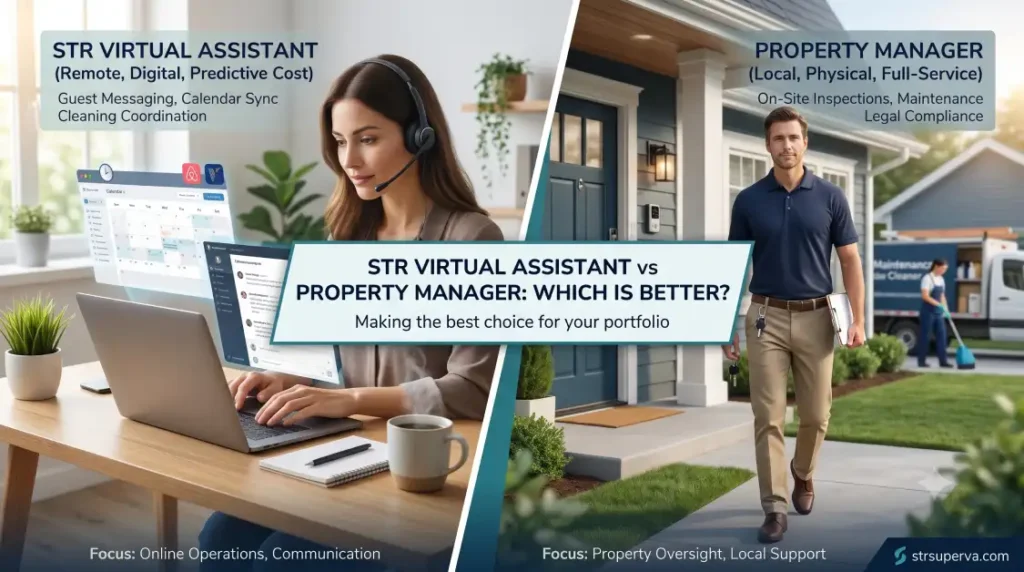
Choosing between the two depends entirely on your portfolio size, budget, and how hands on you want to be. A short term rental virtual assistant is usually much cheaper and handles all digital tasks, while a property manager takes over everything including on site work for a higher fee. Many hosts actually start with a remote assistant to keep profits high, only moving to a manager when they step away completely.
Introduction
In the debate of an STR virtual assistant vs property manager, neither is always better, as the right choice depends on your desired control, cost limits, and daily task preferences. You can save money with a remote team, or you can spend more for local oversight.
If you want to keep your profit margins intact, finding a reliable short term rental virtual assistant is a great first step. They handle the digital side of hosting, while a traditional property manager handles the physical side.
This guide will compare the cost structure, tasks handled, level of control, and scalability of both options. It also aligns with guidelines found on Airbnb’s co-hosting policies, helping you understand who handles what. To start, you need a clear picture of what each option actually does for your business.
What does an STR virtual assistant actually do?
An STR virtual assistant works remotely and handles the digital and communication side of property management, such as guest messaging and calendar management, without going on site. They are your primary digital operator.
These assistants respond to guest inquiries on Airbnb and other booking channels. They manage your calendars, check your dynamic pricing, and ensure your availability is accurate across platforms.
They also act as the communication hub for your local team. A virtual assistant coordinates cleaners, schedules maintenance requests, and writes guest reviews. They often provide basic owner reporting via email or spreadsheets, keeping you informed daily.
A typical remote assistant handles these specific tasks:
- Responding to new booking inquiries rapidly.
- Sending pre-arrival instructions and access codes.
- Answering guest questions during their stay.
- Scheduling local cleaners for turnovers.
- Dispatching handymen for minor maintenance issues.
- Writing and publishing guest reviews.
- Updating pricing software and syncing calendars.
- Filing simple damage claims with booking platforms.
You now need to contrast that with what a traditional STR property manager offers on the ground.
What does a short term rental property manager handle?
A short term rental property manager usually offers full service, including guest communication, on site checks, and vendor coordination, in exchange for a large percentage of your revenue. They completely replace the owner in daily operations.
These managers provide a local presence in your market. They can handle physical key exchanges if you still use them, and they conduct routine physical inspections of the property.
They own the local vendor relationships, paying cleaners and handymen directly. Often, they take over major decision making from the owner, leaving you as a silent investor.
A full service manager usually covers these physical tasks compared to a VA:
- Conducting in person checks after guest issues.
- Overseeing large maintenance projects and renovations.
- Meeting with city inspectors for permit renewals.
- Stocking physical supplies like toilet paper and coffee.
- Handling owner payouts and local bank relationships.
This natural division of labor leads into a direct comparison of costs and control between the two.
STR virtual assistant vs property manager: key differences at a glance
The main differences are cost structure, on site presence, decision making control, and scalability as you add more listings. Understanding these differences protects your profit margins.
Managers often charge around 20 to 40 percent of your gross booking revenue, depending on your market and their service level. Conversely, an Airbnb focused remote assistant often charges an hourly rate or a flat monthly fee, making them significantly cheaper per property.
| Factor | STR virtual assistant | Property manager |
| Typical cost structure | Hourly or flat monthly retainer | 20 to 40 percent of booking revenue |
| On site presence | Remote only | Local, can visit property |
| Tasks handled | Messaging, calendar, coordination | Full operations plus on site oversight |
| Owner control | Owner keeps most decisions | Manager often makes operational decisions |
| Scalability with more units | One VA can support several listings | Fees rise as revenue and units increase |
Many hosts actually combine both approaches to save money, or they start with a virtual assistant and add specific local contractors when needed.
When is a short term rental virtual assistant the better choice?
A virtual assistant is usually better for hosts who want to stay in control, reduce costs, and already have local cleaners and vendors in place. They fit perfectly into an established, well oiled machine.
This setup is ideal if you own one to ten units in one or two markets. If your local cleaners are already working well, you do not need to pay a manager to oversee them.
The owner remains fine making final decisions, but they want someone in their inbox and systems daily. You can easily hire STR virtual assistant support to handle those repetitive tasks, keeping your focus on growth.
Here is a simple decision path for choosing a remote assistant:
- You still want to set strategy, pricing rules, and house standards.
- You already have local cleaners and tradespeople you trust.
- You mainly need help with time consuming digital tasks.
- You prefer paying a predictable monthly amount instead of a large percentage fee.
If this sounds like your current situation, finding an Airbnb VA for property management is the most logical next step. If someone wants to be almost completely hands off, a traditional management company might fit better.
When is a property manager the better choice for your STR?
A property manager is often better when the owner wants a near hands off experience and values local oversight more than savings. They are perfect for passive investors.
Typical situations include out of state or out of country owners without local contacts. If you do not have a reliable cleaner, a local manager solves that problem instantly.
High end luxury properties often require on site checks and white glove service, which a manager can provide. Some owners simply prefer a single local firm to handle everything, including relationships with the city and vendors.
Tasks that truly require a manager or local operator include:
- In person inspections after major guest damage.
- Overseeing long term property renovations.
- Meeting local health or safety inspectors on site.
- Hand delivering physical items to angry guests.
- Serving as the legal local contact for city permits.
Many hosts actually sit between these extremes, looking for a hybrid solution based on their exact needs.
How to decide between an STR virtual assistant and a property manager
The right choice comes from matching your goals, budget, and local support network to what each option actually covers. You must map your current business before hiring anyone.
Follow this simple framework to make your final choice:
- Clarify your goalDecide if you want to maximize profit, free your time, or exit operations almost entirely. Profit seekers favor remote assistants, while passive investors favor managers.
- Audit your local teamList who you already have locally, such as cleaners, handymen, and trusted vendors. If this list is strong, you only need remote digital help.
- Estimate cost scenariosRun numbers for a full service manager fee versus paying a VA plus local vendors. For example, a manager taking 25 percent of a 100,000 dollar revenue is 25,000 dollars, while a flat rate remote assistant might cost only a fraction of that amount.
- Decide your control levelChoose whether you want final say on pricing, refunds, and guest approvals, or if you want to hand that over to a manager.
- Consider growth plansThink about whether you want to scale into more markets, where a flexible VA setup and clear SOPs may grow better. Local managers restrict you to one specific geographic area.
Write down your answers to these five points today. If your answers point toward keeping control and maximizing profits, a short term rental virtual assistant is built exactly for you.
Frequently Asked Questions
Is a virtual assistant or property manager cheaper for an Airbnb?
A virtual assistant is almost always cheaper than a local property manager. Remote assistants usually charge hourly or a flat monthly rate, which is far cheaper than a 20 to 40 percent management fee, but this requires the owner to keep some responsibilities.
Can an STR virtual assistant replace a property manager completely?
A virtual assistant can often replace most day to day management for owners who already have reliable cleaners and vendors. However, they cannot do on site tasks, meet local inspectors, or sign legal documents in the owner’s place.
What tasks should I give a virtual assistant versus a property manager?
Digital, repeatable tasks like messaging, calendar updates, and cleaner scheduling belong to the remote assistant. On site supervision, large repairs, local networking, and legal representation belong with a licensed manager or the owner.
When should I switch from self managing with a VA to a property manager?
You should switch when you face triggers like massive portfolio growth, moving far away, complex local regulations, or severe personal burnout. These specific signs suggest a full service manager might be better for your mental health.
Can I use both a virtual assistant and a property manager together?
Yes, some owners use both together to balance their workload. They use a property manager for local on site tasks and a remote assistant for data analysis, marketing, or multi market support, but they must define clear roles to avoid duplication.
How do I hire STR virtual assistant support for my properties?
You start by defining your daily tasks, setting your required hours, and knowing your budget. You can then hire STR virtual assistant professionals through a trusted agency to streamline the vetting and training process.
Conclusion
There is no universal winner between an STR virtual assistant and a property manager, but most growth focused hosts can keep more control and profit by starting with a VA plus a local vendor network. Your decision defines your future profit margins and daily stress levels.
To recap, a remote assistant handles your digital tasks and communication for a predictable flat rate. A property manager handles everything, including local physical tasks, but they take a large percentage of your gross revenue. A remote assistant fits active owners, while a manager fits entirely passive investors.
Make a one page list of your current tasks, run a simple cost comparison, then schedule a short call to discuss your options. You can easily secure your Airbnb VA for property management today, or call 866-328-9826 to see if our team can handle your operations.