
If you’ve started researching virtual assistants, you’ve probably hit the same wall most business owners do: the job titles overlap so much that it’s hard to tell what you’re actually hiring for. “Admin VA,” “executive assistant,” “executive VA” — they all sound like they handle the same inbox-and-calendar work, so why do the rates and responsibilities vary so widely?
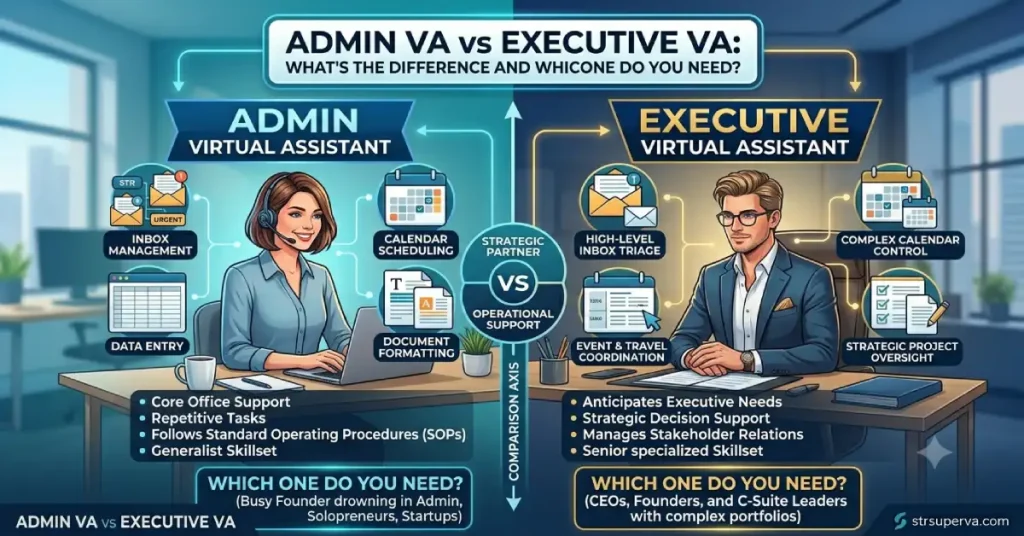
The short answer: an admin VA executes day-to-day operational tasks you assign — email, scheduling, data entry, document prep. An executive VA does that same work, but also exercises judgment on your behalf — triaging what deserves your attention, managing stakeholders, and protecting your time without needing instructions for every decision. One is built for task volume. The other is built for trust and autonomy.
That distinction matters more than it sounds like it should, because hiring the wrong one usually means one of two outcomes: you overpay for strategic-level judgment you didn’t need, or you underhire and end up micromanaging someone who was only ever meant to follow a checklist. Here’s how to tell which side of that line your business actually sits on.
What Is an Admin Virtual Assistant?
An admin virtual assistant is your operational backbone. They handle the recurring, rules-based work that keeps a business running smoothly: monitoring and sorting your inbox, scheduling and confirming appointments, entering and cleaning up CRM data, formatting documents, tracking expenses, and coordinating tasks across your team’s project boards.
The defining trait of admin VA work is that it’s largely definable. You can write a process for it. “When a lead fills out the form, add them to the CRM, send the welcome email, and tag the deal stage” is a workflow an admin VA can run independently once trained — but the decision logic was already built by you. They’re trained on the tools you already use (Google Workspace, Asana, ClickUp, HubSpot, Trello, and similar platforms), so there’s minimal ramp-up time once you hand off a task.
This is the right fit when your bottleneck is volume, not judgment — when you know exactly what needs to happen, you just don’t have the hours to do it yourself.
What Is an Executive Virtual Assistant?
An executive virtual assistant operates closer to a chief of staff than a task-doer. They still manage your calendar and inbox, but the work is layered with discretion: deciding which meeting requests get priority, drafting stakeholder communications in your exact voice without a script, preparing board decks and pre-read briefings, and coordinating directly with investors, partners, or clients on your behalf.
The defining trait of executive VA work is ambiguity. There usually isn’t a fixed process for “handle this investor’s follow-up email” or “rebuild my week because three meetings just got bumped.” An executive VA is trained to read context, weigh priorities, and make the call — then loop you in only when it actually requires your input. That requires a higher level of business fluency, confidentiality handling, and trust than a standard task-based VA role.
This is the right fit when your bottleneck is decision fatigue — when the problem isn’t that tasks exist, it’s that every task seems to need your judgment before it can move forward.
Admin VA vs Executive VA: Key Differences
| Factor | Admin VA | Executive VA |
|---|---|---|
| Core function | Executes defined, recurring tasks | Exercises judgment on ambiguous, priority-based work |
| Typical tasks | Email sorting, scheduling, data entry, document formatting | Stakeholder communication, board prep, complex calendar protection, confidential matters |
| Decision-making | Follows your established process | Makes independent calls within your guidelines |
| Communication scope | Internal team and routine client follow-ups | Investors, board members, partners, senior leadership |
| Confidentiality level | Standard business data | High-trust, sensitive, and confidential information |
| Best fit for | Solopreneurs, small teams, growing operations | Founders, CEOs, senior leaders managing multiple stakeholders |
| Onboarding focus | Tool training and process handoff | Voice-matching, judgment calibration, and trust-building |
Both roles overlap on the surface — calendar management and inbox work show up on either list. The difference isn’t what gets touched, it’s how much discretion is required to touch it well.
Which One Do You Need? Signs to Look For
You probably need an admin VA if:
You can describe most of your bottleneck in a sentence that starts with “I just don’t have time to…” — answer every email, update the CRM, schedule every call, format every proposal. If the tasks are clear and repeatable and your real constraint is hours in the day, an admin VA closes that gap immediately. This is also the more budget-friendly entry point if you’re hiring virtual support for the first time and want to test the model before scaling up.
You probably need an executive VA if:
Your bottleneck sounds more like “I’m the only one who can decide…” — which meetings matter, how to respond to a sensitive client situation, what goes in front of the board, how to reprioritize a week that just fell apart. If delegation keeps failing because every task eventually loops back to needing your judgment, that’s the signal you need someone trusted to absorb that judgment layer, not just the task list underneath it.
A useful test: the “while you’re on a flight” test
Imagine you’re unreachable for six hours. An admin VA keeps your inbox sorted and your calendar accurate until you land. An executive VA can field an urgent investor email, decide it needs your input vs. a same-day reply on your behalf, and have already drafted both options by the time you do. If you need the second outcome and don’t have it today, that’s your answer.
Can the Same Person Do Both?
In practice, yes — many executive VAs started as admin VAs and grew into the role as trust and business context built up over time. The skill sets aren’t mutually exclusive; executive support is really admin support plus judgment, stakeholder fluency, and discretion layered on top. If you’re not sure which level you need yet, it’s reasonable to start with admin-level support, see where the remaining bottleneck lives, and scale into executive-level support once it’s clear that judgment — not task volume — is the constraint.
This is also why it’s worth working with a provider that offers both roles rather than locking into one title. Your needs at five employees look different than your needs at fifty, and the right support should be able to grow with you instead of forcing a re-hire every time your responsibilities shift.
Cost Considerations
Because executive VA work carries more responsibility, judgment, and confidentiality, it’s typically priced higher than admin VA support. That said, the comparison isn’t really about hourly rate — it’s about what each role frees up. An admin VA gives you back hours. An executive VA gives you back decisions. For a founder whose time is genuinely the company’s most expensive resource, the ROI math often favors executive-level support even at a higher rate, because the alternative is the founder continuing to make every call personally.
Frequently Asked Questions
Is an admin VA the same as an executive assistant?
No, though they overlap. An admin VA handles defined day-to-day tasks like email, scheduling, and data entry. An executive assistant (or executive VA) takes on higher-level priorities, stakeholder communication, and independent decision-making — going beyond task execution into judgment-based support.
Can an admin VA become an executive VA over time?
Yes. Many executive VAs build into the role after demonstrating reliability and gaining enough context on your business to start exercising independent judgment, rather than starting there on day one.
Which is more affordable, an admin VA or an executive VA?
Admin VA support is generally the more budget-friendly option since it involves task execution rather than high-trust decision-making. Executive VA support costs more but typically replaces work that would otherwise fall back on you or a senior team member.
Do I need an executive VA if I’m not a CEO?
Not necessarily by title — but if your role involves managing other people’s priorities, fielding stakeholder communication, or making frequent judgment calls that get delegated to you, executive-level support can apply even outside the C-suite.
Can I switch between an admin VA and executive VA later?
Yes. It’s common to start with admin VA support to handle volume, then add or transition to executive VA support as your business grows and the bottleneck shifts from “too many tasks” to “too many decisions.”
Bottom Line
The real distinction between an admin VA and an executive VA isn’t job title — it’s whether your bottleneck is task volume or decision-making judgment. If you’re not sure which one fits, the safest move is a short conversation about your actual workload rather than guessing from a title alone.
Talk to STR Super VA about your day-to-day workload, and we’ll help you match with the right level of support — whether that’s a dedicated admin virtual assistant to take ownership of the details, or an executive virtual assistant to protect your time and judgment at the highest level.