
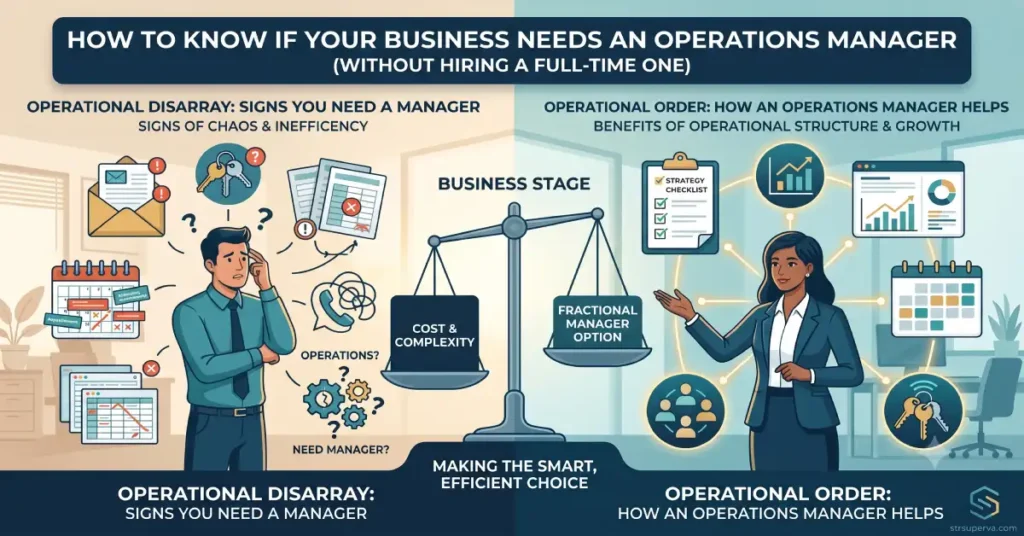
You know your business needs an operations manager when you spend most days fixing problems instead of improving the business, but you are not ready to hire a full time manager. That gap is common. Operations start to feel messy as a business grows, but a full time operations manager at a six figure salary is not realistic for most small teams.
Fractional and virtual operations support can cover the same functions more flexibly. This is especially true for short term rental hosts and online business owners who run lean teams across multiple properties or projects. A operations manager virtual assistant can step in and manage the systems side of the business without the cost of a full time hire.
To see if you are at that point, start by looking at the signs in your day to day work.
TL;DR
You likely need operations support if fires, bottlenecks, and confusion keep pulling you away from strategy and sales. A full time operations manager is expensive, but a remote operations manager virtual assistant can manage processes, projects, and team coordination part time. This article walks through clear signs and a simple way to decide if this kind of support fits now.
What does an operations manager actually do in a small business?
An operations manager makes sure the business runs smoothly by designing processes, managing workflows, and tracking performance so the owner is not stuck in the weeds. The role exists to manage how work gets done, not to do all the work itself.
In practice, this covers process mapping, SOP creation, resource planning, team coordination, and fixing recurring bottlenecks. There is a real difference between completing tasks and managing how tasks get completed. A cleaner does the cleaning. An operations manager makes sure cleanings happen on schedule and get fixed quickly when something goes wrong. This distinction shows up across both operations manager and online business manager roles.
Here is what this looks like in concrete terms:
- Translate the owner’s goals into clear quarterly priorities
- Build and maintain SOPs for key workflows
- Set up simple KPIs and dashboards
- Coordinate projects across team members and vendors
- Spot and fix recurring issues in service, delivery, or communication
Once you understand what the role covers, the next question is whether your business has reached the point where you need it.
Signs your business is ready for an operations manager
You are ready for an operations manager when growth has created more chaos than capacity and you are the only one holding the systems together. This usually shows up gradually, then all at once.
The owner ends up answering team questions and solving small problems most days instead of planning ahead. Projects stall because nobody is clearly responsible for moving them across the finish line. Mistakes repeat, deadlines slip, and the customer experience shifts depending on who handles a request.
Here are specific signs to check against your own week:
- You constantly switch between strategy and small urgent tasks
- Team members are confused about priorities or responsibilities
- You cannot step away for a week without things slowing down
- You have no simple dashboard of key numbers
- New hires take a long time to become productive because nothing is documented
- You see the same problems every month with no permanent fix
- Decisions wait on you even when someone else could make them
If several of these feel familiar, the next question is how to get operations support without taking on a full time salary.
Why many owners cannot justify a full time operations manager yet
Many owners know they need operations help, but a full time operations manager is hard to justify because of cost and scope. The math rarely works until a business reaches a certain size.
Based on typical job postings and salary data, small company operations managers often command $60,000 to $90,000 a year, with COO level roles running well above that. Add benefits, payroll taxes, and hiring time, and the real cost climbs further. Most small businesses also do not generate enough volume to keep a full time operations manager fully engaged at a strategic level every day.
Here is how the main options compare:
| Option | Pros | Cons |
|---|---|---|
| Full time operations manager | Deep involvement, on site leadership | High salary, benefits, long hiring process |
| Owner manages operations | Full control, no extra payroll | Burnout, limited capacity, slow improvements |
| Fractional or virtual ops help | Flexible hours, focused on priorities | Requires clear scope and communication |
This is where a remote operations manager virtual assistant becomes a practical middle path.
What is an operations manager virtual assistant?
An operations manager virtual assistant is a remote specialist who manages your systems, workflows, and team coordination part time so you get operations leadership without a full time hire. The role sits between a general task focused VA and a traditional operations manager.
A general VA executes assigned tasks. An operations manager virtual assistant operates a level higher, focused on systems, processes, projects, and metrics across the whole operation. This person is not a full executive, but can translate your vision into a clear plan and then manage execution through your existing team. Most work remotely and bring strong experience with project management tools, SOP documentation, and team communication.
Typical responsibilities include:
- Map and document key workflows
- Set up project boards and checklists for recurring work
- Coordinate with your STR VA, admin VA, and local vendors
- Track weekly KPIs and flag issues
- Prepare simple owner or leadership reports
A well structured operations manager virtual assistant role can absorb most of the coordination work that currently sits on your desk. The next section looks at when this virtual option makes more sense than waiting to hire full time.
When a virtual operations manager makes more sense than a full time hire
A virtual operations manager usually makes more sense when your business is complex enough to need systems, but not yet large enough for a full operations salary. This describes a large share of growing STR portfolios and online businesses.
This fits well when your revenue and team are growing, but you still have fewer than, say, 10 to 20 staff or contractors. It also fits when you have multiple projects, offers, or properties, yet you are still personally deciding and coordinating most of it. Much of this work happens online, in shared tools that a remote ops assistant can access just as easily as someone sitting next to you.
Use this simple decision guide:
- List your biggest recurring operational headaches
- Estimate how many hours per week you spend on coordination, follow up, and fixing issues
- Compare that to the cost of part time remote ops support versus a full time manager, for example a $70,000 annual salary against a monthly retainer for part time support
- Ask whether you want to test structured operations support for a few months before committing to a full hire
For STR owners, this often means coordinating cleaners, handling emergency maintenance coordination, managing smart lock and access workflows, and keeping owners updated without tracking every detail yourself. One host running eight listings could not take a full week off until she added part time operations support to manage these moving pieces. The next section outlines exactly what this role can take off your plate.
What an operations manager virtual assistant from STR Super VA can take off your plate
An operations manager virtual assistant from STR Super VA can own your systems, projects, and recurring workflows so you stop being the bottleneck. This is not generic admin support. It is built specifically around STR and small business operations.
This role coordinates directly with your other VAs and local teams, sitting above day to day task execution and below full executive ownership. It is worth being honest about limits here too: a virtual operations manager cannot physically inspect a property or sign legal documents, but can manage the people who do both of those things reliably.
Here is the work typically organized by category:
Systems and processes
- Document SOPs for guest communication, turnovers, and maintenance flows
- Keep a central operations manual updated
Team and vendor coordination
- Run weekly team check in agendas
- Track cleaner, contractor, and vendor commitments and issues
Metrics and reporting
- Maintain a simple KPI sheet for occupancy, response times, and project status
- Prepare monthly owner or leadership summaries
Projects and improvements
- Lead small process improvement projects, such as reducing missed cleanings or response time
If this kind of operations manager virtual assistant support sounds like what your business is missing, the FAQs below answer the questions most owners ask before reaching out.
Frequently Asked Questions
What are signs my business needs an operations manager?
Direct signs include constant firefighting, unclear responsibilities, repeating mistakes, and stalled projects. If you spend more time coordinating and fixing than planning and selling, operations leadership is missing, even without an official manager title in place.
Do I need a COO, an operations manager, or just better systems?
A COO sets strategic direction at the executive level, an operations manager runs day to day systems, and many businesses simply need better documented processes first. Most small and mid sized businesses improve systems and add part time operations support before ever hiring a full COO.
How is an operations manager virtual assistant different from a regular VA?
A regular VA mainly executes assigned tasks. An operations manager VA designs and manages the tasks, people, and workflows behind those tasks. Think of it as the difference between someone who answers guest messages and someone who builds and runs the system for how guest messages get handled.
How many hours per month does a virtual operations manager usually work?
Many operations manager virtual assistants start around 20 to 40 hours per month for smaller operations, with flexibility to scale up during busy seasons. That is often enough to bring real structure, without paying for a full time manager’s salary and benefits.
Can a virtual operations manager help with my short term rentals?
Yes. This includes coordinating guest support VAs, cleaners, smart lock changes, and emergency maintenance, while keeping owners and investors updated on performance. STR Super VA specializes in exactly this kind of short term rental operations environment.
How do I get started with an operations manager virtual assistant?
Start by listing your current operational headaches so you know what to ask for. From there, get started with STR Super VA or call 866-328-9826 to talk through scope and fit.
Conclusion
Many owners reach a stage where they clearly need operations leadership, but a full time operations manager is not yet realistic. A virtual operations manager fills that exact gap, covering systems, coordination, and accountability without full time payroll.
The signals are consistent: constant firefighting, unclear ownership, repeat issues, and no one driving systems forward. If that sounds like your week, the pattern is unlikely to fix itself on its own.
Take ten minutes today and list your top five recurring operational problems. Then either visit the operations manager virtual assistant page to see how the role works in detail, or get started with STR Super VA directly to talk through your specific situation.