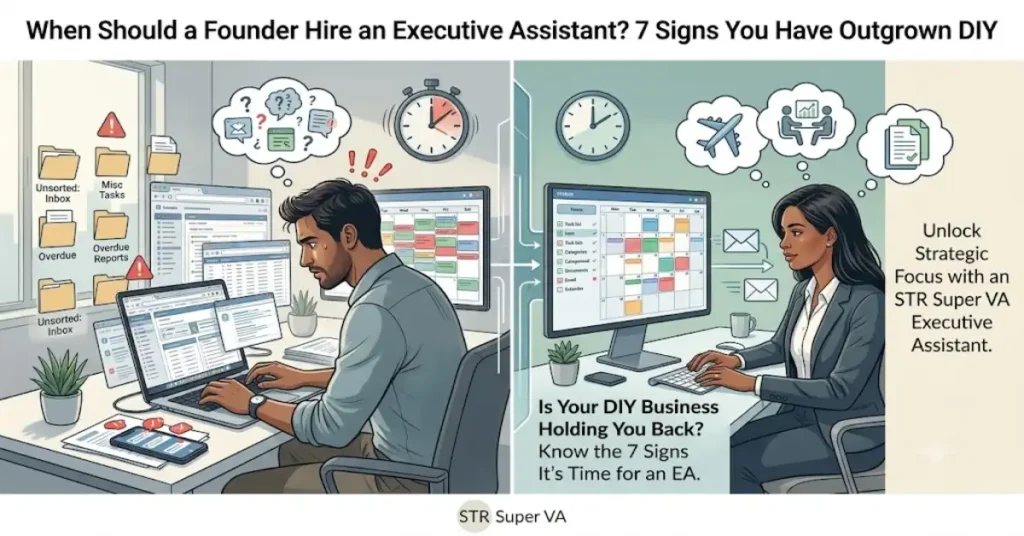
A founder should hire an executive assistant when their calendar, inbox, and decisions consume so much time that growth work keeps slipping to tomorrow. That is the real trigger, not headcount, not revenue, and not how big your team looks on paper.
In practice, the signal is simpler than most founders expect. It is the volume of repeatable work sitting on your plate that no longer needs your brain to get done well. Scheduling, inbox triage, follow ups, and meeting prep do not require your judgment once someone has the right context. They just require your time.
Here is the catch. Great founders usually hit this point earlier than they expect, and most wait far longer than they should. You tell yourself it is faster to just do it yourself. For a while, that is even true. Then one day it is not, and you cannot tell exactly when that changed.
This is where senior level support comes in, without the cost or commitment of an in office hire. An executive virtual assistant gives you that same calendar protection, inbox management, and follow through, but remotely and often part time to start. Before you post a job ad, here is a quick summary of what to look for.
TL;DR
It is time to hire an EA when you spend most of your week managing email, meetings, and small decisions instead of revenue, product, or strategy. Those tasks usually add up to 10 to 20 hours a week, which a remote executive assistant can handle at a lower cost than your own time. The rest of this article walks through seven specific signs, plus how an executive virtual assistant covers each one.
What Does an Executive Assistant Really Do for a Founder?
An executive assistant protects the founder’s time and focus by managing their calendar, communication, and follow through so they can lead instead of chase tasks.
Think of a good EA as a second brain. They filter incoming requests, organize the information landing in your inbox, and keep your priorities moving even when you are heads down on something else. You are not handing off busywork so much as you are handing off the cognitive load of tracking it all.
This is also where an EA differs from a general admin VA. An admin VA executes tasks you assign, clearly and reliably. An EA goes a step further. They use judgment to decide what matters, what can wait, and what needs to reach you immediately. That distinction matters more than it sounds, and we break it down fully in admin VA vs executive VA.
In practice, a strong EA typically owns:
- Calendar ownership and protecting your focus blocks
- Inbox triage and drafting responses in your voice
- Preparing agendas and following up after key meetings
- Coordinating with your team and outside vendors
- Handling confidential tasks and the personal logistics that bleed into your workday
The next sections cover seven specific signs that you are ready for this kind of support.
Sign 1: Your Calendar and Inbox Are Running Your Week
The first sign you need an executive assistant is when your calendar and inbox dictate your day instead of your priorities.
Most founders start here without noticing. You spend an hour each morning booking calls, rescheduling conflicts, and digging through email for one message you swear you read yesterday. As a result, you are reacting to your inbox instead of working from a plan.
That constant context switching has a real cost. Important opportunities sit unanswered while you put out smaller fires, and by the time you respond, the moment has often passed.
A few signals make this one easy to spot:
- You regularly miss or reschedule important calls because of scheduling conflicts
- You check email constantly and still feel behind
- You cannot find key information quickly when you need it
An EA fixes this by managing inbound requests, blocking real focus time on your calendar, and enforcing simple rules about what actually deserves a meeting. If this sounds familiar, you will likely recognize the second sign too, which is closely linked to constant context switching.
Sign 2: You Are Stuck in Constant Context Switching and Mental Overload
It is time for an EA when your days feel like a string of small tasks and decisions, with no space to think deeply.
However, the issue is not just the number of tasks. It is the switching between them. Jumping from a Slack message to an approval to a quick call and back again creates decision fatigue, even when none of those individual tasks felt hard on their own.
That fatigue has a hidden cost. By the afternoon, the strategic thinking your role actually requires gets the lowest energy version of you, not the sharpest one.
Here is what that shift can look like in practice:
| Aspect | Without EA | With EA |
|---|---|---|
| Morning | Clearing inbox, fixing calendar issues | Review curated priorities and key messages |
| Midday | Ad hoc calls and approvals | Focus blocks, EA handles quick decisions |
| End of day | Catch up on tasks and admin | Short review, next day planned by EA |
This mental overload connects directly to the next sign, which is about tasks that clearly should not be on the founder’s plate in the first place.
Sign 3: You Are Doing Work That Someone Else Could Do at Least 80 Percent as Well
Another clear sign is when you spend more than 5 to 10 hours a week on repeatable tasks that someone else could handle with clear instructions.
A simple way to check this is a one week time audit. Track everything that is repeatable, does not rely on your specific relationships, and recurs often enough to matter. For example, scheduling, formatting reports, or chasing the same three vendors every month.
If that adds up to more than about 5 hours, an EA starts to make sense. As a result, above 15 hours a week, you are already late to the decision, not early.
A quick framework to run this yourself:
- Write down every task you repeat weekly
- Mark which ones genuinely need your judgment
- Tally the rest
- If the total is above 5 hours, it is time to explore EA support
The next sign focuses on what happens when this work piles up unattended, namely missed opportunities and dropped balls.
Sign 4: Opportunities and Follow Ups Are Slipping Through the Cracks
You likely need an EA if warm leads, investor emails, or key relationships are not getting timely follow up.
This shows up quietly at first. A founder forgets to reply to an important email for two weeks, then finally does, embarrassed, hoping the other person did not notice. That said, they usually did.
The cost compounds from there. Deals slow down, partnerships cool off, and press opportunities go to someone faster.
A few patterns make this one obvious:
- You discover messages from important people buried days later
- Prospects ask if you actually got their last email
- You have no simple system to track your own commitments
An executive virtual assistant can own a simple CRM or follow up tracker, keep your warm relationships alive, and prep you properly before key calls. Founders in this situation often also notice that internal communication has gotten messy, which is the next sign.
Sign 5: Your Team Is Waiting on You for Everything
Another sign you need an executive assistant is when your team constantly waits for you to answer small questions or approve routine items.
This bottleneck slows everything down, even projects that have nothing to do with your specific input. An EA can act as a gatekeeper and router here, answering what they reasonably can and organizing the rest so you are only pulled in when it truly matters.
Common patterns to watch for:
- Slack or email full of “quick questions” that pile up by midday
- Team members asking you to find documents or information you already have somewhere
- You are the default person scheduling every internal meeting
In practice, an EA can also help set up better systems, documentation, and recurring cadences so fewer decisions need to route through you at all. The sixth sign moves outside the office, into how this spills over to your personal life.
Sign 6: Your Personal Life Is Suffering Because Logistics Never Stop
You may need an EA when personal and work logistics blend together so much that family, health, and rest repeatedly lose.
For example, founders end up booking their own travel late at night, forgetting bills, or missing appointments that actually matter, all because there was no clear stopping point between work and everything else.
That pattern does not stay contained. Over time, it feeds directly into burnout and worse decision making, exactly when you need to be sharpest.
A good EA can take real ownership here:
- Booking and adjusting travel as plans shift
- Managing key personal appointments that affect your work week
- Handling simple personal admin that drains energy without requiring your judgment
A remote EA can often support both business and carefully defined personal tasks, which makes the overall value higher than people initially expect. The final sign is less about a specific task and more about a feeling, namely that the business is capped by your own bandwidth.
Sign 7: You Feel Like the Business Could Grow Faster If You Had a Right Hand
The final sign is when you know your business has room to grow, but your own capacity is the ceiling.
This usually feels like having more ideas and more demand than you can act on. You know exactly what should happen next. You just cannot get to it fast enough on your own.
A true executive assistant becomes a strategic right hand at this point, not just someone completing tasks. The difference shows up clearly when you compare the two roles side by side.
| Role | Primary Focus | Best For |
|---|---|---|
| General virtual assistant | Completing assigned admin tasks | Inbox cleanup, data entry, scheduling |
| Executive assistant | Managing founder priorities and workflows | Protecting time, anticipating needs, coordination |
If you are nodding along to several of these signs, you are likely searching for an executive assistant, not a general VA. That distinction matters because it points you toward someone built for judgment and prioritization, not just task completion. From here, it is worth seriously considering remote executive assistant options as your next step.
Why an Executive Virtual Assistant Is Often the First Smart Step
For many founders, an executive virtual assistant is the best first step because it delivers true EA support without a full time in office hire.
Remote EAs handle the same high level work as a traditional in office EA, but the hours and cost flex to what you actually need right now. That said, cost is worth a closer look here. General VAs typically run lower hourly rates because the work is more task based. Executive assistants cost more because you are paying for judgment, prioritization, and the ability to represent you well, and when your time is genuinely valuable, that math works in your favor quickly.
Working with a specialized firm like STR Super VA adds a few specific advantages on top of that:
- Pre trained in common business tools and founder workflows, so ramp up is fast
- Able to support both short term rental specific tasks and general executive work
- Easy to start with part time hours and scale up as your needs grow
If you want to see exactly what this looks like day to day, our executive virtual assistant page walks through the full scope of support available. Founders usually have a few of the same questions before making this move, so let’s cover those directly.
Frequently Asked Questions
How do I know if I am ready for an executive assistant?
Start with the strongest signals: you are overwhelmed by admin work, opportunities are slipping through the cracks, and your days feel like constant context switching with no room to think. If two or three of those sound like your current week, you are ready to explore EA support seriously.
Should I hire a virtual assistant or an executive assistant first?
It depends on what you need handled. A VA executes clearly defined tasks well. An EA manages your priorities and workflows with judgment, not just a task list. If you feel like you need a right hand who can think a step ahead, you are likely ready for EA level support, not just task execution.
How many hours per week should an executive assistant work for a founder?
Most founders start realistically at 10 to 20 hours a week. That is typically enough to manage your calendar, triage your inbox, and handle key follow ups without overcommitting before you know exactly how the working relationship fits.
What tasks should I give an executive assistant first?
Start with high impact, recurring work: calendar management, inbox triage, meeting prep, and tracking your open commitments. These tasks repeat weekly, do not require your personal presence, and free up real time almost immediately.
Can an executive virtual assistant handle confidential information safely?
Yes, when you work with a credible provider. Look for firms that vet their EAs, use signed confidentiality agreements, and rely on secure tools. In practice, it also helps to use a password manager and limit access at first, expanding it gradually as trust builds.
How do I get started with an executive virtual assistant through STR Super VA?
Start by listing your current pain points, the tasks eating your week that do not need your judgment. From there, get started with STR Super VA or call 866 328 9826 to talk through what makes sense to delegate first.
Conclusion
Founders should hire an EA when their time is mostly consumed by coordination, admin, and small decisions, the kind of work that someone with strong judgment and good systems thinking can handle just as well. That is the real trigger, not a specific revenue milestone or team size.
A few signs tend to matter most: your calendar and inbox are running your week instead of the other way around, opportunities are slipping through the cracks because follow up has no owner, and your team keeps waiting on you for things that do not actually need your judgment.
A good next step is simple. Track one week of your own tasks, add up the hours that match these signs, and see where you land. If the number surprises you, visit our executive virtual assistant page or fill out the get started with STR Super VA form to see if a part time EA is the right next move. If you would rather just talk it through, call 866 328 9826 and we can walk through your specific situation together.