Roofing operations run in intense cycles where demand shifts overnight. After a major hail or wind storm, office phones ring nonstop for weeks, inspection requests pile up, and insurance paperwork multiplies rapidly. During quieter retail months, that same team has to chase every single inquiry to keep crews busy. In both environments, roofing company owners and sales reps often spend their days climbing roofs to run estimates and their evenings buried in administrative catch-up.
When estimators are in the field, new inquiries cool off quickly and sent proposals stall without a clear next step. Partnering with STR Super VA to integrate dedicated virtual assistant services for roofing companies solves this pipeline bottleneck by separating administrative execution from field sales. By placing a trained remote professional in charge of inbound capture, appointment routing, and multi-touch proposal tracking, contractors turn missed calls and cold quotes into booked estimates.
Why Roofing Leads Slip Through the Cracks
Roofing is a high-ticket home service where response timing directly dictates revenue. Missing a single phone call after a severe weather event can easily cost a contractor a replacement project worth thousands of dollars. Even when a homeowner leaves a voicemail or submits a web form, most roofing prospects will not call a contractor back on their own.
Industry data shows that while 95% of leads convert after the sixth follow-up attempt, most contractors abandon outreach after just one or two tries. When your field reps are responsible for both inspecting roofs and chasing down unscheduled inquiries, four operational gaps consistently drain revenue:
- Delayed initial response: Storm leads frequently wait a full day or longer for a callback while estimators are on ladders or driving between jobs.
- Scattered inquiry channels: Leads arrive simultaneously via phone calls, website forms, emails, referrals, and paid ads without a unified intake workflow.
- Orphaned roofing proposals: An estimator visits a property and emails a quote, but fails to follow up consistently while the homeowner compares three competing bids.
- After-hours blind spots: Evening and weekend inquiries hit voicemail instead of reaching a live coordinator who can lock in an inspection slot immediately.
Stage 1: Speed-to-Lead and Instant Inbound Capture
Capturing more estimates starts within the first five minutes of a homeowner reaching out. A dedicated roofing virtual assistant monitors your business phone lines, website contact forms, email inbox, and social media messages in real time—including evening and weekend hours when homeowners are most likely to research contractors.
Rather than acting as a basic answering service that merely takes a message, a trained roofing VA follows your custom intake script to pre-qualify every prospect on the spot. Before dispatching a sales representative to a property, the VA verifies core qualification criteria so your estimators only spend fuel and time on legitimate opportunities:
- Property ownership: Confirming whether the caller is the legal homeowner with decision-making authority rather than a tenant.
- Project classification: Identifying whether the homeowner needs an insurance restoration claim inspection or a retail roof repair or replacement.
- Roof condition: Documenting the approximate roof age, visible shingle or leak damage, and immediate urgency level.
- CRM documentation: Entering complete contact information, property details, and lead source tags directly into your roofing CRM.
If an inbound call goes missed during a peak call surge, the VA triggers an immediate callback and text follow-up within minutes so the homeowner never feels ignored.
Stage 2: Strategic Inspection Scheduling and Route Optimization
Once a prospect is qualified, the immediate objective is locking in a firm inspection date and time. When scheduling is left to individual sales reps, appointment details often end up scattered across text threads, paper notebooks, and personal calendars. A roofing VA centralizes calendar management across your entire sales team.
Territory-Based Routing A virtual assistant coordinates inspection slots around each estimator’s assigned geographic territory. Grouping appointments by neighborhood or zip code minimizes drive time between roof inspections and allows each rep to run more estimates per day.
Pre-Inspection Preparation Booking the appointment is only half the setup. Before the estimator pulls into the driveway, your VA orders aerial measurement reports through platforms like EagleView or Hover and creates a dedicated project folder in CompanyCam. The sales rep arrives at the home with property measurements, damage notes, and historical context ready for review.
Appointment Confirmations To protect your team from wasted trips, the VA sends automated and personal pre-inspection instructions as soon as the slot is booked. They follow up 24 hours prior to confirm the homeowner will be present and handle any rescheduling requests on the fly so calendar gaps can be backfilled immediately.
Stage 3: The Multi-Touch Cadence for Unscheduled Leads
Not every web form submission or ad lead picks up the phone on the first attempt. When a homeowner requests information online and disappears, a roofing VA places the prospect into a structured multi-touch follow-up sequence combining phone calls, SMS text messages, and emails at defined intervals.
| Touchpoint | Timing | Channel | Primary Objective | VA Action |
| Touch 1 | Under 5 Mins | Phone & SMS | Instant speed-to-lead | Call lead and send intro text |
| Touch 2 | Hour 3 | Deliver company credentials | Send reviews and booking link | |
| Touch 3 | Day 2 | Phone Call | Qualify roof issue | Call during alternate time window |
| Touch 4 | Day 4 | SMS Text | Prompt quick reply | Offer two specific inspection times |
| Touch 5 | Day 7 | Email & Call | Address common concerns | Share financing or insurance FAQ |
| Touch 6 | Day 14 | Phone & SMS | Final active check-in | Confirm if roof project is still open |
This structured cadence ensures no marketing dollar is wasted. Because 95% of conversions require six or more touchpoints, having a VA systematically work leads across phone, text, and email bridges the exact gap where competing contractors give up. Every call attempt, text reply, and status change is logged inside your CRM so your sales manager has complete visibility into pipeline conversion rates.
Stage 4: Post-Inspection Estimate Follow-Up That Closes Deals
Many roofing proposals go unsigned not because the homeowner disliked the price, but because post-inspection follow-up was inconsistent or nonexistent. After an estimator inspects a roof and sends over a quote, homeowners typically need time to review figures, discuss options with a spouse, or compare three competing bids.
A roofing VA tracks every open proposal on a dedicated pipeline board and enforces a strict 24-hour post-estimate follow-up rule. Reaching out within the first 24 hours keeps your company top-of-mind before the re-engagement window closes. Furthermore, effective VA outreach avoids vague check-ins and instead proposes a clear, time-specific next step.
24-Hour Post-Estimate Email Script Subject: Estimate review for your roof project on [Street Name]
Hi [Homeowner Name], thank you for having [Estimator Name] out to inspect your roof yesterday. We sent over the detailed estimate for your shingle replacement and underlayment work, and I wanted to make sure the proposal arrived safely in your inbox. Because reviewing roofing scopes and material options often brings up a few questions, we would love to walk through the numbers with you briefly. Does tomorrow at 10:00 AM or Thursday at 4:00 PM work for a quick 10-minute phone review with [Estimator Name]?
48-Hour Estimate Follow-Up Call Script Hello [Homeowner Name], this is [VA Name] calling from [Company Name]. How are you doing today? I am following up on the roofing estimate [Estimator Name] prepared for your property earlier this week. Many homeowners have questions about material warranties, project timelines, or financing options once they look over the figures, so I wanted to see how the proposal looked to you. If you have a few minutes, I can connect you with [Estimator Name] right now, or we can lock in a quick call for tomorrow afternoon—would 2:00 PM or 4:30 PM suit your schedule better?
5-Day Proposal Check-In SMS Script Hi [Homeowner Name], it is [VA Name] with [Company Name]. We are finalizing our crew production schedule for the next two weeks and wanted to check in on your roofing proposal. Do you have any questions about the scope of work or shingle colors that we can answer for you today?
When a prospect replies with a technical question or pricing objection, the VA logs the response immediately and alerts the assigned sales rep to step in and close the contract. If a homeowner decides to go in another direction, the VA updates the CRM stage and closes the loop politely on a positive note.
Database Reactivation, Storm Triage, and Neighborhood Outreach
Beyond managing active inbound inquiries and fresh quotes, a roofing virtual assistant drives outbound estimate volume from assets you already own:
- Cold database reactivation: Your VA systematically calls and texts older, unconverted leads in your CRM who requested a quote months ago but postponed their project.
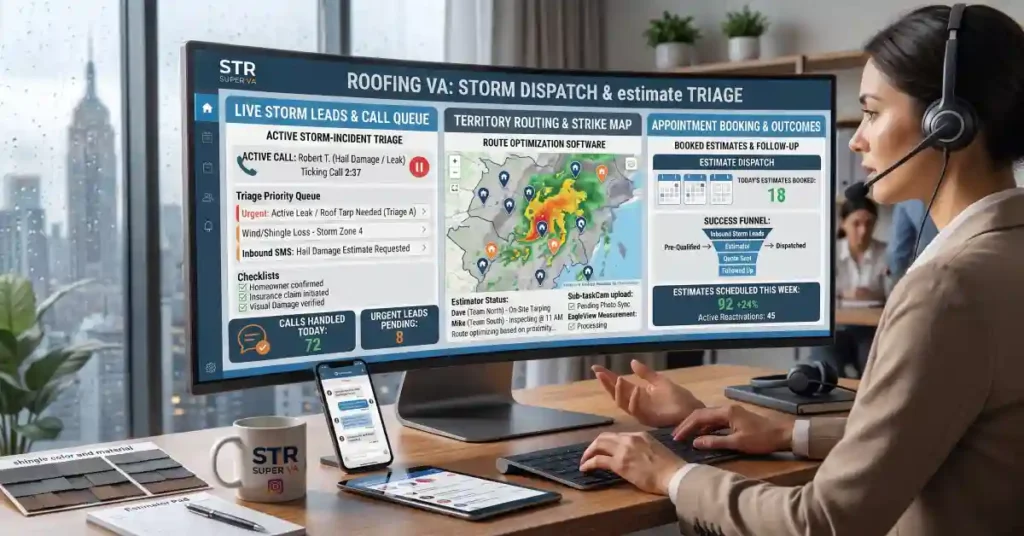
- Storm surge triage: When hail or high winds hit your service area, the VA segments incoming inquiries by severity and location so emergency tarping and active leaks get prioritized.
- Past client check-ins: After local weather events, your VA contacts past customers to offer complimentary roof checks, generating high-converting referral leads at zero ad cost.
- Canvassing list follow-up: When field teams drop door hangers around active job sites, the VA follows up with neighboring property owners via phone and mailings to book cluster inspections.
Roofing CRMs and Software Tools Your VA Manages
A specialized roofing VA plugs directly into your existing software ecosystem using role-based security permissions. Rather than forcing you to change how you operate, your assistant keeps your current platforms clean and up to date:
- Roofing CRM platforms: Managing lead pipelines, task boards, and communication logs inside AccuLynx, JobNimbus, Roofr, Leap, JobProgress, or ServiceTitan.
- Visual & measurement software: Organizing job photos in CompanyCam and ordering aerial roof measurement packets via EagleView or Hover.
- Insurance & estimating files: Assembling Xactimate documentation prepared by your estimators, uploading photos to insurance portals, and tracking supplement or recoverable depreciation paperwork.
- Billing & review systems: Tracking invoice milestones in QuickBooks or Xero and sending Google review requests within 48 hours of final payment.
Setting clear operational boundaries keeps your business compliant and efficient. Your virtual assistant serves as dedicated administrative and sales support—not a licensed public adjuster or field estimator. While your VA schedules adjuster meetings, requests claim statuses, and sends approved documentation, all roof climbing, technical assessments, scope pricing, and policy coverage negotiations remain strictly with your qualified field professionals.
Choosing the Right Support Level and Onboarding Your VA
Scaling a roofing company requires matching the right remote talent to your specific operational bottlenecks. If you are deciding between dedicated lead-handling support and higher-level operations management, start by comparing an admin VA vs. an executive VA to see how each role impacts your daily workflow.
For many contractors, recognizing the key signs it is time to hire an executive assistant happens when storm leads wait days for a callback, claim files sit untouched on desks at night, and final depreciation checks take months to collect. While an administrative coordinator focuses on speed-to-lead and calendar booking, growing multi-crew contractors often utilize executive virtual assistant services to oversee full production schedules, coordinate material deliveries with suppliers, and compile weekly executive pipeline reports.
Once you define your ideal role, following our step-by-step guide to hiring an admin virtual assistant ensures a smooth launch. A structured 30-day onboarding timeline transitions responsibilities in clear weekly phases:
- Week 1 (Inbound & Booking): Master your speed-to-lead phone scripts, pre-qualification rules, and estimator territory calendars.
- Week 2 (Estimate & Claim Tracking): Launch the 24-hour post-estimate follow-up cadence and assemble inspection claim packages for estimator sign-off.
- Week 3 (Production Coordination): Manage material order confirmations, crew calendar updates, and automated homeowner installation alerts.
- Week 4 (Collections & Reviews): Track ACV and recoverable depreciation payments, follow up on overdue invoices, and automate post-install Google review outreach.
Frequently Asked Questions
How quickly should a roofing company follow up on new leads?
A roofing company should respond to new inbound leads within five minutes of the initial inquiry and always follow up on sent estimates within the first 24 hours. Fast response times prevent homeowners from booking with competing contractors while their roofing issue is urgent.
How many follow-up attempts does it take to book a roofing estimate?
Research shows that 95% of converted roofing leads are won on or after the sixth follow-up attempt. Using a virtual assistant to execute a consistent multi-touch sequence across phone calls, SMS texts, and emails ensures prospects are nurtured until they are ready to schedule.
What tasks can a roofing virtual assistant handle during storm season?
During storm season, a roofing virtual assistant handles instant call answering, lead pre-qualification, storm damage triage, estimator route scheduling, aerial measurement ordering, insurance claim packet organization, and daily homeowner status updates.
Can a virtual assistant work directly inside AccuLynx or JobNimbus?
Yes, a trained roofing virtual assistant works directly inside industry CRMs including AccuLynx, JobNimbus, Roofr, Leap, JobProgress, and ServiceTitan using the custom security permissions and stage workflows your company sets.
Can a roofing virtual assistant negotiate with insurance adjusters?
No, a roofing virtual assistant does not negotiate policy coverage or scope pricing with insurance adjusters. Instead, the VA handles administrative claim support by uploading photos, submitting estimator-approved Xactimate files, scheduling adjuster inspections, and tracking supplement or depreciation checks.
How much does hiring a roofing virtual assistant save compared to in-house staff?
Hiring a dedicated roofing virtual assistant can reduce labor costs by up to 80% compared to hiring a local in-house office administrator, while also eliminating payroll taxes, employee benefits, and physical office space expenses.
Turn More Roofing Inquiries Into Booked Estimates
Stopping pipeline leaks does not require adding expensive local office overhead or working until midnight to return calls. When a trained remote specialist owns your lead intake, estimator routing, and post-inspection follow-up, your sales reps spend their hours on roofs closing deals rather than chasing voicemails.
Explore our specialized virtual assistant services for roofing companies to see how we tailor workflows around your CRM and sales targets. Ready to pack your inspection calendar and boost your estimate close rate? Complete our quick intake form to get started with your custom VA match or call our team directly at 866-328-9826 today.